Are Wood Blinds for Sliding Door Setups Actually Too Heavy to Lift?
I remember staring at an 8-foot expanse of glass in my first 'grown-up' apartment, convinced that wood blinds for sliding door setups were the peak of architectural chic. They look like a high-end library, right? Then I tried to actually open them to let the dog out at 6 AM, and realized I had basically installed a gym membership on my wall. It is the classic design dilemma: do you choose the look you love or the function you actually need?
- Single-panel wood blinds over 72 inches are a mechanical nightmare to hoist daily.
- A 'two-on-one' headrail is the industry secret to making wide spans functional.
- Faux wood handles patio door condensation significantly better than real timber.
- Mounting 'outside' and 'high' prevents the dreaded head-bump from the slat stack.
The Elephant in the Room: They Are Ridiculously Heavy
A standard 80-inch sliding glass door is a massive amount of real estate. When you choose wooden blinds for sliding glass doors, you are asking a thin nylon cord and a small plastic pulley to lift roughly 25 to 35 pounds of kiln-dried basswood. It is not just about the strength of the person pulling; it is about the physics of the tilt mechanism and the sheer stress on your drywall anchors.
Hoisting a continuous 80-inch span of solid wood is mechanically counterintuitive for a door that glides sideways. You are fighting gravity to move something that should really be moving horizontally. Every time you pull that cord, you are wearing down the internal locking mechanism. Within a year, you will likely notice the blind hanging slightly lower on one side—the dreaded 'blind sag.'
The 'Two-on-One Headrail' Trick I Use Everywhere
Here is the trick I use for every client who insists on this look: the two-on-one headrail. You order two separate blind units but specify they share a single, continuous valance at the top. This is how you make wood patio door blinds actually work for a living. It creates the visual illusion of one massive, expensive unit while allowing you to operate them independently.
You can lift the 36-inch panel over the active door handle to let the breeze in while leaving the stationary side down for privacy. This setup cuts the lifting weight in half and ensures that even if one cord eventually fails, you aren't left with a completely exposed glass wall. It is the only way to save your rotator cuff and your sanity.
Real Wood vs. Faux Wood on a Sweaty Patio Glass
Choosing wood blinds for patio exits requires a quick lesson in material science. Sliding doors are notorious for 'sweating.' On cold nights, that glass hits the warm indoor air and creates a microclimate of moisture right against your slats. Real timber is porous. I have seen $800 custom basswood blinds turn into Pringles—warping and bowing—within two seasons of heavy humidity.
Modern composite faux wood is actually the designer-approved choice here. While it is technically heavier than real wood, it is waterproof and heat-resistant. It won't crack under the direct UV blast that hits a patio door all afternoon. If you want the look of grain, high-end composites now have realistic 'wire-brushed' textures that fool almost everyone from three feet away.
Why You Need Extra Clearance Above the Trim (The 'Stack' Problem)
If you mount wood blinds directly onto the door trim, you are going to regret it. This is because of 'stack height.' When a 2-inch wood blind is fully raised, those slats have to go somewhere. A standard 80-inch blind will have a compressed stack of about 10 to 12 inches at the top. If your door is 80 inches tall, you have just lowered your clearance to 68 inches. Everyone over 5'8' will be ducking every time they go outside.
To fix this, mount the headrail 6 to 10 inches above the casing. This ensures the stack clears the glass entirely when raised. If your ceiling height doesn't allow for that massive gap, you might consider day night shades as an alternative. They compress into a much tighter, lower-profile stack that won't scalp your taller guests.
When to Abandon the Idea and Try Alternatives
I will be brutally honest: if your sliding door is the main thoroughfare for kids, muddy dogs, or frequent tray-carrying hosts, horizontal slats might be the wrong tool for a sideways job. Sometimes, vertical blinds for patio sliding doors are simply more intuitive because they move in the same direction as the door. They have come a long way from the clacking plastic of the 90s; look for fabric-wrapped versions for a softer architectural vibe.
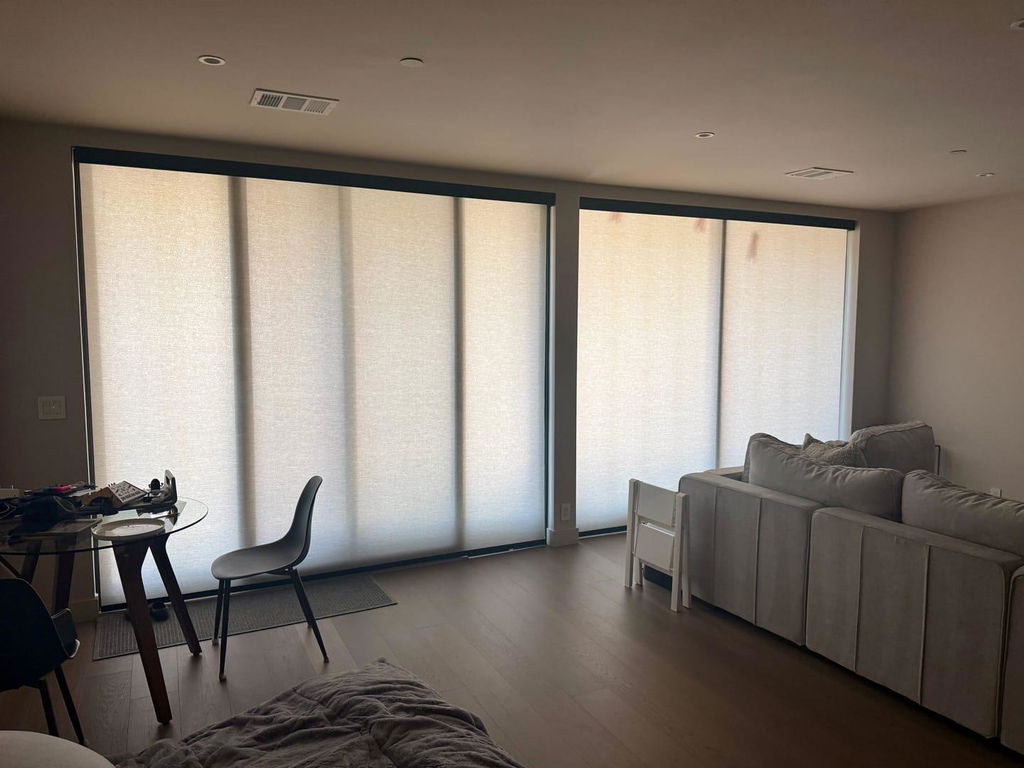
For those who want a minimalist look, modern roller shades offer a streamlined, lightweight alternative that avoids the heavy stacking issue entirely. And if light leakage drives you crazy, blackout roller blinds for patio doors provide a much tighter seal than any wooden slat ever could. Sometimes the best design choice is knowing when to pivot.
Frequently Asked Questions
Can I use a single blind for a 72-inch door?
Technically, yes, many manufacturers will make it. However, the weight will eventually snap the internal cords or pull the brackets from the wall. I always recommend splitting the span into two blinds under one valance.
Does faux wood look cheap?
Not anymore. Avoid the high-gloss plastic versions. Look for 'embossed' or 'sandblasted' finishes in matte tones. They mimic the texture of real oak or basswood without the risk of warping near the glass.
How do I clean wood blinds on a high-traffic door?
Use a vacuum brush attachment once a week. Because patio doors are often near kitchens or backyards, they catch more dust and grease. For deep cleans, a damp microfiber cloth with a tiny bit of wood soap works wonders on faux wood.