Why Your Blackout Curtains for Patio Door Setups Look So Heavy
I remember standing in my first apartment, staring at a massive sliding glass door that felt less like a feature and more like a giant heat-leaking radiator. In a fit of desperation to stop the 4 PM glare on my TV, I ran to a big-box store and bought the first set of blackout curtains for patio door I could find. Within an hour, my living room didn't look like a home; it looked like a budget motel. The fabric was stiff, the rod was sagging in the middle, and the whole thing felt suffocatingly heavy.
- Avoid 'triple-pass' acrylic backing if you want a natural drape.
- Switch to a traverse track system for any span wider than 60 inches.
- Opt for a one-way draw to keep the fabric out of your walking path.
- Aim for 2.5x fullness to prevent the 'bedsheet' look.
The 'Motel Drape' Problem (And Why It Happens)
Most room darkening patio door curtains look terrible because of how they are manufactured. To achieve that 100% light block, many manufacturers spray a thick, rubbery acrylic coating directly onto the back of the fabric. This makes the panel stiff as a board. Instead of falling in soft, organic folds, these blackout drapes for patio doors hang in awkward, angular chunks.
If you want your sliding glass door blackout curtain to look high-end, you have to look for 'dimout' fabrics or, better yet, curtains with a separate, sewn-in lining. A separate lining allows the face fabric—whether it is linen or velvet—to move independently. This creates that 'fluid' look you see in magazines, where the fabric seems to float rather than just hang there like a heavy tarp.
Track vs. Rod: Why Hardware Makes or Breaks the Look
Standard curtain rods are the enemy of a functional sliding glass door room darkening curtains setup. Why? Because a sliding door is wide. To support the weight of blackout panels for sliding glass doors, you need center brackets. Those brackets become permanent roadblocks, preventing you from sliding your curtains all the way to one side.
I spent years fighting with rings that got stuck on the junction of a telescoping rod. I Hid $30 Paper Blackout Shades Behind My Good Drapes for 6 Months while I saved up for a proper traverse track, and the difference was night and day. A traverse track allows the carriers to slide past the support brackets, meaning you can move ten feet of heavy blackout curtains for sliding glass doors with a single finger. It is the only way to handle the sheer weight of 100-inch wide panels without the rod bowing like a pool noodle.
The One-Way Draw: The Only Way to Hang Them
Stop trying to split your blackout drapes for sliding glass door down the middle. Unless you have a French door setup that opens from the center, a center-split curtain is a functional nightmare for a slider. You end up with a pile of fabric blocking the stationary side of your door, and another pile getting caught in the handle of the sliding side.
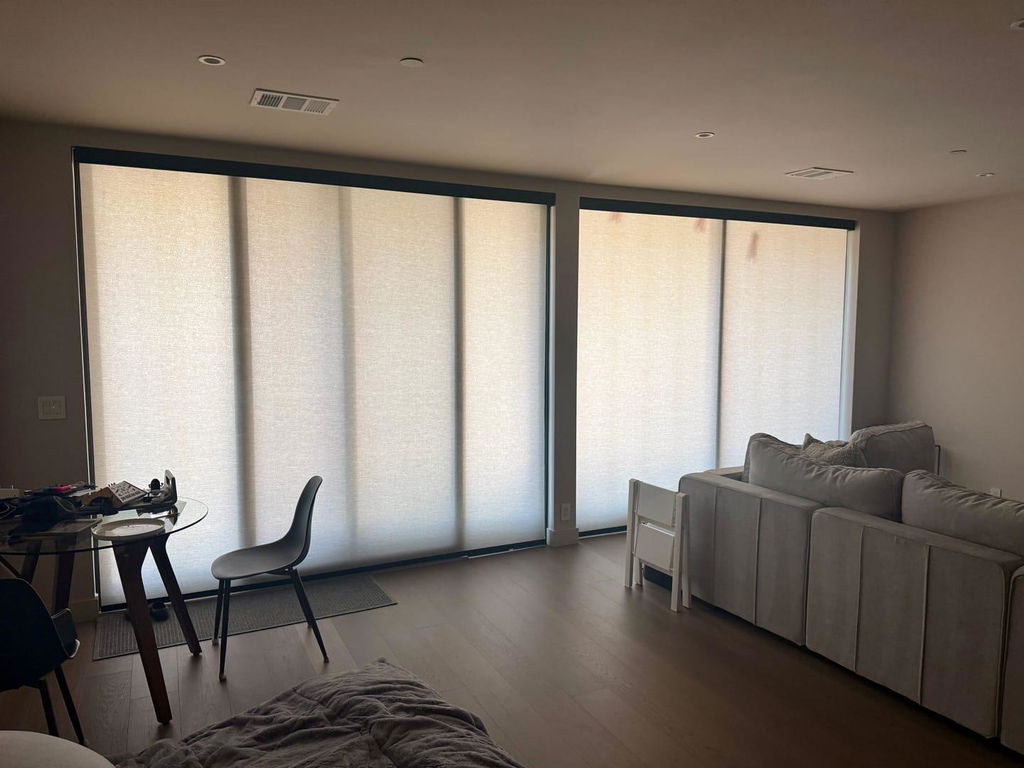
The 'one-way draw' is the professional's secret for sliding door blackout curtains. You hang one massive, continuous panel (or several panels trained to move as one) that stacks entirely to the side of the door that doesn't move. This keeps your high-traffic zone clear and makes the sun blocking curtains for sliding glass doors look intentional rather than an afterthought. When they are open, you have a clean view; when they are closed, you have a seamless wall of fabric.
Choosing Fabric Weights That Actually Move
If you want that designer look, you need to talk about GSM (grams per square meter). For a blackout curtain for glass door, you want something substantial but not rigid. A blackout curtains for sliding door setup using a 200-250 GSM Blackout Linen gives you that beautiful, slubby texture that catches the light during the day while keeping the room pitch black at night.
For north-facing rooms that feel a bit chilly, I often suggest Blackout Cozy. It has a heavier visual weight and a soft, tactile finish that helps with sound dampening—huge if your patio door faces a noisy street. The key is to ensure the fabric has enough 'heft' to puddle slightly. I usually add 1/2 inch to my floor-to-ceiling measurements so the sliding door blackout panels just kiss the floor, hiding any unevenness in the architecture.
What If You Only Need the Darkness at Night?
Sometimes, the sheer volume of patio door blackout panels is too much for a small room. If you love the look of light, airy sheers but need to kill the glare for movie nights, layering is your best friend. You can install a double track: a sheer layer in front for the 80% of the day you want natural light, and a hidden sliding patio door blackout curtains layer behind it that only comes out when the sun gets aggressive.
If you find that a full wall of heavy fabric is overwhelming your space, check out different Blackout Room Darkening weights. You might find that a high-density weave provides enough light blockage for your needs without the bulk of a total blackout lining. It’s about finding the balance between 'movie theater dark' and 'living room comfortable.'
My Biggest Mistake
I once ordered a 120-inch wide custom panel for a client's slider and forgot to account for the 'stack back.' When the curtains were open, they still covered almost 20% of the glass. It made the room feel half as bright as it should have been. Now, I always extend my track at least 10-12 inches past the door frame on the 'stack' side. It makes the window look twice as large and ensures every drop of sunlight can get in when the curtains are open.
FAQ
Do I need two panels or one for a sliding door?
Technically, you can use two, but one large 'one-way draw' panel is much more functional. It prevents light leaks in the center and keeps the fabric away from the door handle you use most often.
How high should I hang curtains over a patio door?
As high as possible. Mounting your blackout curtains for sliding glass door just a few inches below the ceiling (or crown molding) draws the eye upward and makes your ceilings feel much taller than they actually are.
Are blackout curtains for sliding doors energy efficient?
Absolutely. Large glass doors are notorious for heat loss in winter and heat gain in summer. A heavy, lined sliding glass door blackout curtain acts as an extra layer of insulation, significantly cutting down your energy bills.